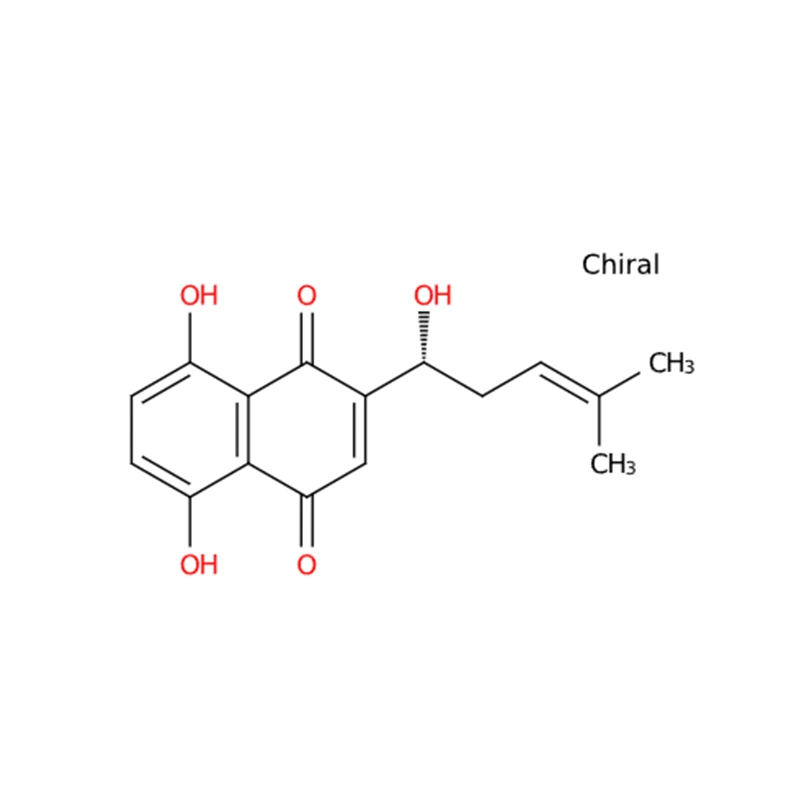
Products Description of Shikonin CAS#517-89-5
Shikonin, a natural naphthoquinone compound extracted from gromwell roots, appears as Reddish-purple crystalline powder under normal ambient conditions. The raw material shows good solubility in organic solvents such as ethanol, acetone and ether, while it barely dissolves in plain-water solution.
This bioactive substance owns multiple valuable pharmacological traits, covering anti-inflammatory, anti-oxidant and wound-healing capacity. It can suppress the proliferation of tumour cells through several signal pathways. Purified shikonin is widely prepared as raw material for skincare supplies, topical ointments and related anti-cancer laboratory research.
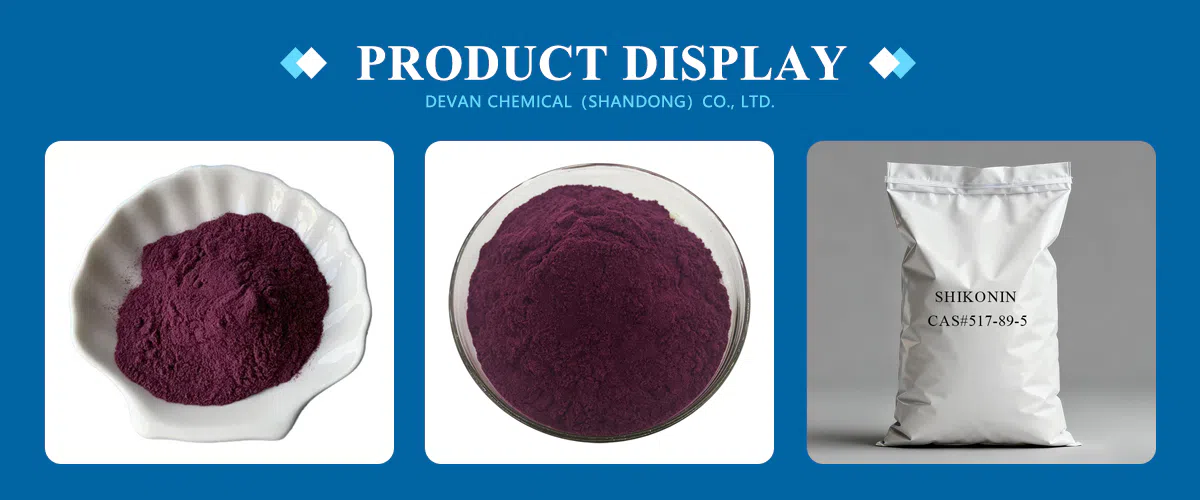
Shikonin Chemical Properties
| Melting point | 148℃ |
| Boiling point | 567.4±50.0 °C(Predicted) |
| density | 1.373±0.06 g/cm3(Predicted) |
| storage temp. | -20°C |
| solubility | DMSO : ≥ 31 mg/mL (107.53 mM); |
| pka | 7.34±0.20(Predicted) |
| form | crystalline solid. |
| color | Reddish-purple |
| LogP | 4.350 (est) |
| CAS DataBase Reference | 517-89-5(CAS DataBase Reference) |
| Risk Statements | 20/21/22-50/53-20 |
| Safety Statements | 26-36/37/39-61 |
| RIDADR | 3077 |
| HS Code | 29146990 |
| Hazardous Substances Data | 517-89-5(Hazardous Substances Data) |

Product Application of Shikonin CAS#517-89-5
This active ingredient carries multiple kinds of biological properties such as anti-inflammatory, anti-oxidant, anti-tumour and wound-healing effects. Plenty of researchers have focused on the cancer-resistant capacity of shikonin and its derived substances in recent years.
Both in-vitro cell tests and living-organism experiments prove that shikonin derivatives are capable of restraining the onset and advancement of gynaecological malignancies covering breast cancer and cervical cancer. It delivers strong anti-tumour activity by slowing cancer-cell multiplication and cellular migration, alongside triggering cell apoptosis, autophagy and necroptosis.
Moreover, shikonin boosts the production of reactive oxygen species (ROS), blocks exosome secretion and strengthens the anti-tumour immune reaction via diversified molecular pathways. It regulates PI3K/AKT/mTOR and MAPKs signal transmission, cuts down the activation of TrxR1, PKM2, RIP1/3, Src and FAK, and adjusts biological targets including ERP57, MMP, ATF2, C-MYC, miR-128 and GRP78 (BiP).