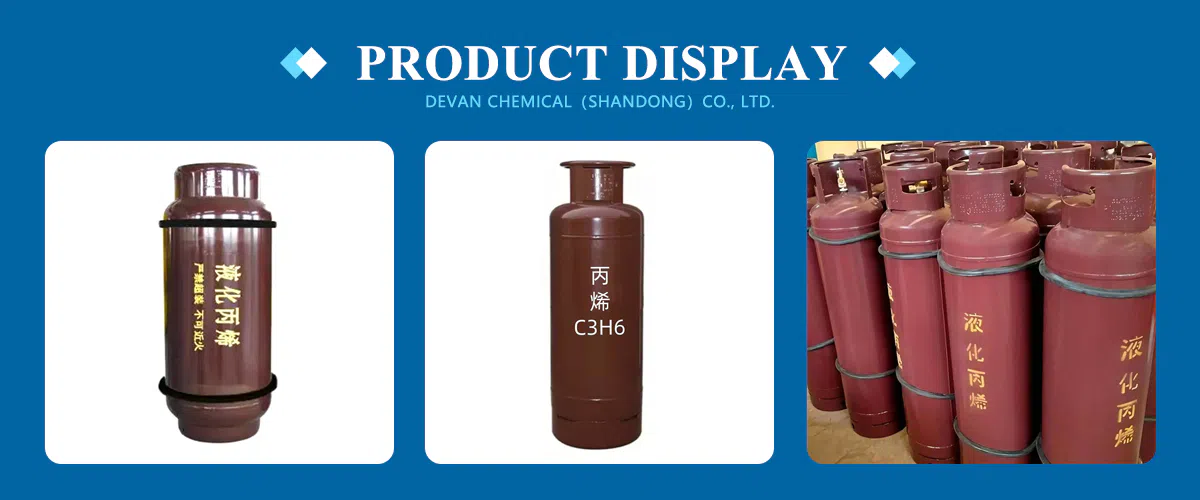
Products Description of Propylene CAS#115-07-1
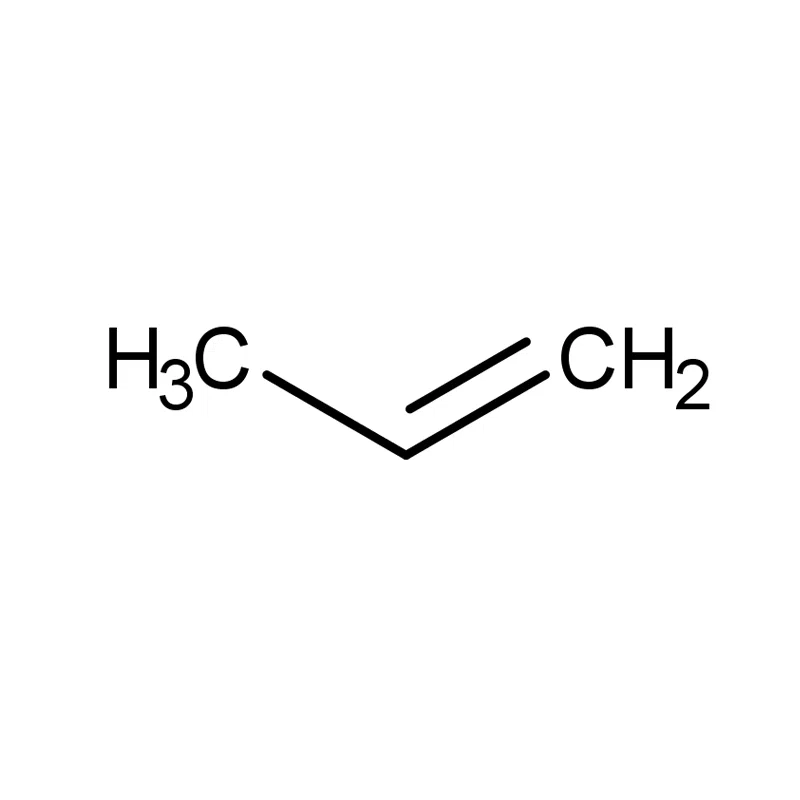
Propylene,molecular formula C3H6, ranks as the second simplest olefin. Following ethylene and benzene, it represents one of the most vital raw materials for organic chemical synthesis.Propylene is generally separated from gas streams generated by thermal cracking and catalytic cracking. It can also be recovered as a by-product when light oil is cracked to manufacture ethylene.Thanks to the unsaturated carbon-carbon double bond in its molecular structure, propylene is capable of undergoing addition reactions with hydrogen, halogens and hydrogen halides, alongside addition polymerization.
As an essential building block, propylene is adopted to manufacture acrylonitrile, polypropylene, ethylene-propylene rubber, propylene oxide, acetone and various synthetic resins. It is also utilized for producing synthetic rubber, synthetic fibers and plastics.
Propylene Chemical Properties
| Melting point | -185 °C(lit.) |
| Boiling point | -47.7 °C(lit.) |
| Density | 1.49 |
| Vapor density | 1.48 (vs air) |
| Vapor pressure | 15.4 atm (37.7 °C) |
| Refractive index | 1.3567 |
| Flash point | -108°C |
| Acidity coefficient (pKa) | 43(at 25°C) |
| Form | colorless gas |
| Explosion limits | 0.111 |
| Odor threshold | 13ppm |
| Water solubility | 0.33g/L(25 °C) |
| Thermal conductivity | 0.11 W/(m-K) |
| Freezing point | -185.25℃ |
| Merck | 137941 |
| BRN | 1696878 |
| Henry's Law Con stant | 5.6x10⁻⁵ mol/(m3Pa) at 25℃, Plyasunov and Shock (2000) |
| Dielectric constant | 1.9 (20℃) |
| Stability | Stable. Highly flammable. Easily forms explosive mixtures with air. Incompatible with strong oxidizers, strong acids, and halogens. |
| InChI | 1S/C3H6/c1-3-2/h3H,1H2,2H3 |
| InChIKey | QQONPFPTGQHPMA-UHFFFAOYSA-N |
| SMILES | CC=C |
| LogP | 1.77 at 20℃ |
Product Application of Propylene CAS#115-07-1
Propylene is a vital building block for the chemical sector and acts as a primary feedstock to manufacture numerous downstream chemical products.Via gas-phase oxidation, propylene can be transformed into acrolein. Acrolein is subsequently applied in the synthesis of acrylic acid, allyl alcohol, glyceraldehyde, hydroxyacetaldehyde, as well as methionine — a significant additive for food and animal feed.
The ammoxidation of propylene generates acrylonitrile, a critical raw material for synthetic fibers, synthetic rubber and plastics. When propylene undergoes chlorination, chloropropylene is formed. This substance can be further converted into intermediates including allyl alcohol and propylene dichlorohydrin and chloropropionitrile. Such intermediates are deployed for producing glycerin, epoxy resins, chlorohydrin rubber and surfactants.
Propylene alkylation yields cumene, the core intermediate for phenol manufacturing, alongside acetone as a high-value co-product. The oxo synthesis of propylene produces n-butyraldehyde and isobutyraldehyde.These two aldehydes function as key intermediates for plasticizers, dyestuffs, solvents, agrochemicals and many other organic compounds.
Furthermore, propylene hydration produces isopropyl alcohol, which is further processed into acetone, isopropylamine and isopropyl esters. Propylene is also capable of dimerization, trimerization, tetramerization and polymerization reactions, generating substances including propylene trimers, polypropylene and dodecene. Dodecene acts as an indispensable intermediate in surfactant manufacturing.