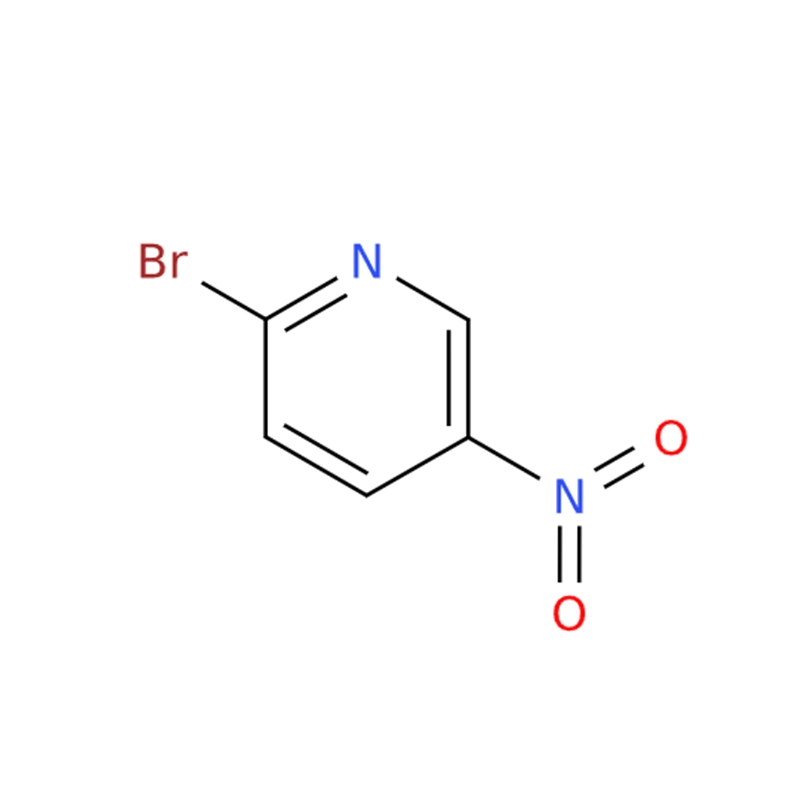
Product Description of 2-Bromo-5-nitropyridine CAS#4487-59-6
This chemical compound appears as crystals ranging from Light yellow to light brown and functions as a vital intermediate for drug-making workflows. One feasible synthetic route to obtain 2-bromo-5-nitropyridine relies on the bromination reaction carried out with 2-hydroxy-5-nitropyridine.
Documented chemical research also indicates the compound works as a core synthetic precursor to produce 2-cyano-5-hydroxypyridine. For this reason, it ranks as a practical molecular building unit for general-purpose organic synthesis as well as medicinal-chemistry research.

2-Bromo-5-nitropyridine Chemical Properties
| Melting point | 139-141 °C (lit.) |
| Boiling point | 145-147 °C/10 mmHg (lit.) |
| density | 1.8727 (rough estimate) |
| refractive index | 1.6200 (estimate) |
| Fp | 145-147°C/10mm |
| storage temp. | Inert atmosphere,2-8°C |
| solubility | Chloroform, Hot Methanol |
| form | Crystalline Powder |
| pka | -3.24±0.10(Predicted) |
| color | Light yellow to light brown |
| Water Solubility | Insoluble in water. |
| BRN | 120901 |
| InChIKey | HUUFTVUBFFESEN-UHFFFAOYSA-N |
| CAS DataBase Reference | 4487-59-6(CAS DataBase Reference) |
| Hazard Codes | Xn,Xi |
| Risk Statements | 22-36/37/38-20/21/22 |
| Safety Statements | 26-37/39-22-36 |
| RIDADR | UN 2811 6.1/PG 3 |
| WGK Germany | 3 |
| Hazard Note | Irritant/Keep Cold |
| HazardClass | IRRITANT, IRRITANT-HARMFUL |
| PackingGroup | III |
| HS Code | 29333990 |

Product Application of 2-Bromo-5-nitropyridine CAS#4487-59-6
2-Bromo-5-nitropyridine acts as a crucial heterocyclic intermediate within organic synthesis and medicinal-chemistry research. Its reactive bromine substituent enables multiple substitution reactions to construct diversified pyridine-based molecular frameworks.
It is widely adopted to synthesize several bioactive pyridine derivatives targeted for pharmaceutical screening. Besides drug-related manufacture, this substance serves as a basic raw-material for developing agro-chemical compounds and laboratory-use chemical reagents.
Many research teams employ it to prepare 2-cyano-5-hydroxypyridine and other fine-chemical products. Operators ought to wear protective gear during handling for the sake of skin-contact risk.