


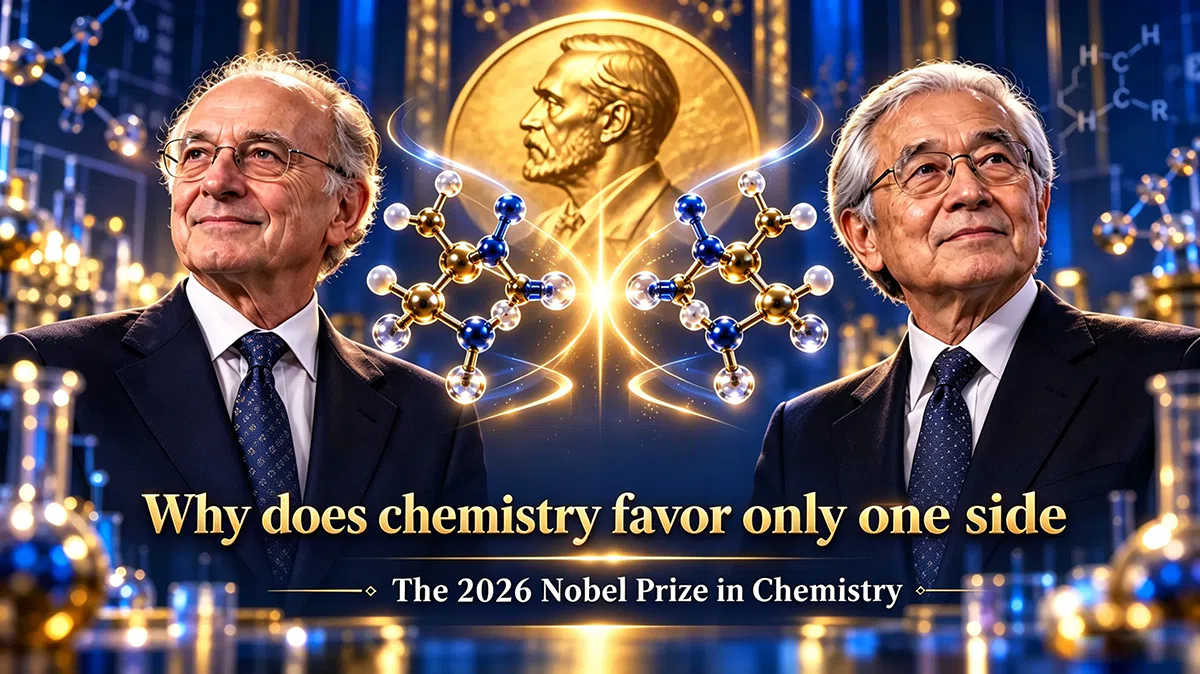
On October 7, 2026, the Royal Swedish Academy of Sciences awarded the 2026 Nobel Prize in Chemistry to French chemist Henri B. Kagan and Japanese chemist Kenso Soai for “the discovery of non‑linear effects and autocatalysis in asymmetric organic synthesis”. This award has refocused laboratory and procurement attention on the long‑standing topic of chiral synthesis. A range of commonly‑used reagents, from chiral ligands to chiral‑pool raw materials, are drawing greater interest amid the Nobel Prize spotlight.
Many molecules (such as amino acids) exist in two mirror‑image forms, yet living organisms utilize almost exclusively one of these mirror forms. Chemists have long puzzled over how this “homochirality” emerged from an originally symmetric world. Kagan uncovered a new approach for manipulating chemical reactions, enabling access to single‑mirror‑image molecules with enantiomeric excess far beyond previous expectations. His findings carry profound implications for chiral synthesis of pharmaceutical intermediates, fragrances, flavours and new functional materials. Soai, by contrast, designed the first chemical reaction that generates only one mirror‑image molecular form — the Soai reaction. It achieves chiral autocatalysis and amplification within a chemical system, a feat previously observed only in living organisms. (Press release, Official Website of the Nobel Prize)
I. Two Core Award‑Winning Concepts: Non‑Linear Effects and Autocatalysis
1. Non‑linear Effects: Small Quantities of Chiral Catalyst Drive Greater Product Chiral Excess
Under conventional understanding, the enantiomeric excess (ee value) of reaction products correlates linearly with the optical purity of the catalyst. Kagan and co‑workers discovered that in certain chemical systems, catalyst ee and product ee follow a non‑linear relationship. Even a catalyst with moderate optical purity can yield products with substantially higher ee values. This amplification mechanism drastically lowers costs for obtaining single‑enantiomer compounds and expands process‑design flexibility for chiral catalysis.
2. Autocatalysis: A Product Catalyses Its Own Formation
First reported in 1995, the Soai reaction represents one of the best‑known chemical autocatalytic systems. The product pyrimidylmethanol catalyses the reaction between its precursor aldehyde and diisopropylzinc to produce more of itself, continuously amplifying enantiomeric excess over successive reaction cycles. It serves as a classic experimental model for investigating the origin of biological homochirality and is widely cited in textbooks covering chiral catalysis and the origins of life.
II. Why Chirality Matters in Laboratory Work
Mirror‑image chiral molecules can exhibit completely divergent odour, taste and biological activity. For a given intermediate, the R‑configuration and S‑configuration may serve entirely different applications. Consequently, efficient access to single‑enantiomer compounds stands as one of the central challenges in route design for pharmaceutical intermediates, fragrances, agrochemicals and functional materials. Common approaches include chiral metal catalysis (using ligands such as BINAP), small‑molecule organocatalysis (e.g. proline‑based systems), the chiral‑pool method (directly employing natural chiral feedstocks such as L‑amino acids), and chiral resolution.
III. The Laboratory Chiral Reagent Toolkit
1. Chiral Phosphine Ligands
BINAP‑class bisphosphine ligands constitute classic backbones for transition‑metal‑catalysed asymmetric hydrogenation and coupling reactions. Both R‑ and S‑enantiomers are commercially available; selection must match the target configuration of your synthetic route.
2. Small‑Molecule Organocatalysts
L‑proline is a representative organocatalyst for asymmetric aldol and Mannich reactions. It is cost‑effective and easy to handle, making it a popular starting point for organocatalysis practice.
3. Chiral‑Pool Raw Materials
Naturally‑occurring chiral building blocks such as L‑serine and L‑glutamic acid possess inherent chiral centres. They can be deployed directly as chiral synthons or precursors for chiral auxiliaries, ideal for synthetic routes requiring a reliably defined chiral source.
4. Boundary Notes and Compliance Reminders
Most chiral reagents require storage under protected conditions: protected from light, low‑temperature environments and sometimes inert‑gas atmospheres. Certain reagents (including some metal catalyst precursors) fall under regulated chemical categories. Before procurement, verify alignment with hazardous‑chemical inventories, GHS hazard classifications, and local transport and storage regulations. Always obtain the most up‑to‑date MSDS/SDS documentation. These reagents are intended solely for scientific research and industrial R&D purposes.
Frequently Asked Questions (FAQ)
Q1: Do non‑linear effects mean low‑ee catalysts can be used arbitrarily?
No. Non‑linear effects are highly system‑dependent. Amplification must be confirmed experimentally and cannot be assumed for every reaction.
Q2: Can the Soai reaction be performed in a standard laboratory?
The Soai reaction is extremely sensitive to water, oxygen and experimental technique. It employs organozinc reagents and must be carried out in suitably equipped laboratories with strict adherence to chemical‑safety protocols.
Q3: What are the critical specifications to check when purchasing chiral ligands?
Absolute configuration (R/S), enantiomeric excess (ee), batch purity, analytical test reports (e.g. HPLC / chiral‑column data), and consistent supply capability from the vendor.
Q4: How should one choose between the chiral‑pool method and catalytic asymmetric synthesis?
The chiral‑pool approach delivers shorter synthetic sequences and lower costs when target molecules share structural similarity with natural chiral feedstocks. Catalytic methods offer greater flexibility for constructing novel chiral centres. Practical synthetic routes frequently combine both strategies.
Disclaimer
This document serves as industry news and scientific reference material for chemistry and materials‑science researchers. It does not constitute product‑performance guarantees or procurement advice, nor does it provide medical diagnostic or therapeutic guidance. Reagent handling must follow the supplier’s latest MSDS/SDS and local regulatory requirements. Citations of third‑party research reflect factual summary only and do not represent the standpoint of this publication.


